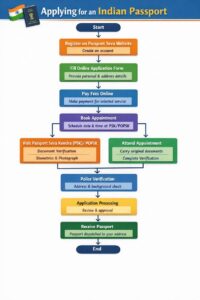
Any Indian citizen can apply for an Indian Passport, right from a new born baby to any age with no limit as such. An Indian passport is an official travel and identity document issued by the Government of India through the Passport Seva Programme under the Ministry of External Affairs. It serves as proof of Indian citizenship and enables international travel. New passports are increasingly issued as ePassports, which contain an embedded RFID chip for enhanced security while remaining valid as ordinary passports. The Indian passport is recognized worldwide and complies with international standards established by the International Civil Aviation Organization (ICAO), allowing it to be used at immigration checkpoints around the world.
There are different types of Indian Passports like the Maroon Passport, White Passport and the Ordinary Passport (Dark Blue). Usually, a Passport has 36 pages which is Normal. But if you are a frequent traveller you can apply for a Jumbo Passport which would contain 60 pages. Also, depending upon your requirement (I mean urgency) you can apply for a TATKAAL passport too which would be dispatched within 8 - 10 working days. Otherwise, the Normal passport takes about 30 – 45 working days.
For Infants or Minors, Birth Certificate and Aadhaar cards (not required for new born babies) are required in addition to Parent’s Passports and Aadhaar cards. In case where one of the parents (usually Father) resides outside India, special documentation is required from their side.
Please Note – For Single Parents, passports cannot be done for their Minor Children.
There are also cases where name change or correction is required either for Fresh Passports or in already existing Passports which requires extra procedure which we handle.
Finally, there are also cases where either Passports are either Lost or Damaged. This is a bit complicated, especially if it is Lost which also can be handled from our end.
A Police Clearance Certificate (PCC) is an official document issued by a police authority or government agency stating whether a person has a criminal record (or confirming that no criminal record is found) during a specified period or in a particular jurisdiction.
People commonly need a PCC for:
- Immigration or permanent residency applications
- Work visas or employment abroad
- Citizenship applications
- International adoption
- Certain jobs, especially those involving children, vulnerable adults, or security-sensitive roles
- Some professional licenses
A typical PCC includes:
- Your full name and identifying information
- The period and jurisdiction covered by the check
- A statement indicating whether any criminal record was found
- The issuing authority's signature, seal, or official authentication
It's important to note that a PCC does not guarantee that a person has
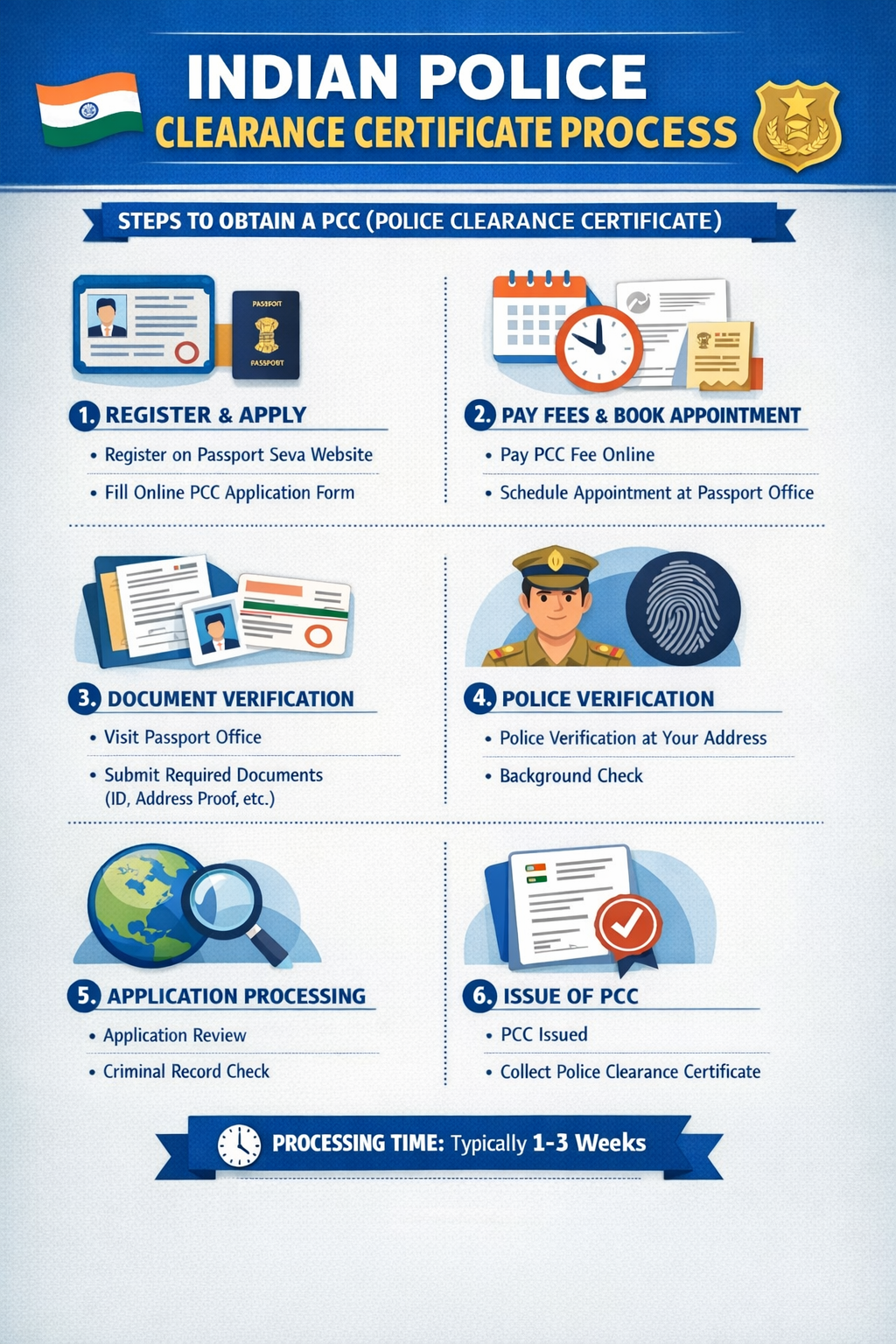
A Police Clearance Certificate (PCC) is an official document issued by a police authority or government agency stating whether a person has a criminal record (or confirming that no criminal record is found) during a specified period or in a particular jurisdiction.
People commonly need a PCC for:
- Immigration or permanent residency applications
- Work visas or employment abroad
- Citizenship applications
- International adoption
- Certain jobs, especially those involving children, vulnerable adults, or security-sensitive roles
- Some professional licenses
A typical PCC includes:
- Your full name and identifying information
- The period and jurisdiction covered by the check
- A statement indicating whether any criminal record was found
- The issuing authority's signature, seal, or official authentication
It's important to note that a PCC does not guarantee that a person has
For an Indian Passport, we need the following documents:
- Birth Certificate (if available)
- Aadhaar Card (current address)
- Election Card or Voter ID (preferably, in current address)
- PAN Card
- Bank statement (Photo attested, latest 3 months statement)
- Rental Agreement (if Rented house)*
- Marriage Certificate (if married)
* ORIGINAL RENTAL AGREEMENT TO BE TAKEN ALONG WITH OWNER’S AND WITNESSES AADHAAR CARDS.
It is pretty much the same as that required for a FRESH Passport except that you need to carry the ORIGINAL Passport too.
- Birth Certificate (if available)
- Aadhaar Card (current address)
- Election Card or Voter ID (preferably, in current address)
- PAN Card
- Bank statement (Photo attested, latest 3 months statement)
- Rental Agreement (if Rented house)*
- Marriage Certificate (if married)
- ORIGINAL PASSPORT
A Tatkaal Passport is an expedited passport service offered by the Government of India for applicants who need their passport urgently due to reasons such as international travel, employment, education, medical emergencies, or other time-sensitive requirements. The passport itself is identical to a normal passport; only the processing priority and fee are different. Under the Tatkaal scheme, eligible applications are generally processed much faster, often with passport dispatch within 1–3 working days after the Passport Seva Kendra (PSK) visit, subject to successful document verification and the applicable police verification process. A Gazetted Officer's Verification Certificate is no longer required for Tatkaal applications.
Documents Required for a Tatkaal Passport (Adults – 18 years and above)
In addition to the standard passport application requirements such as:
- Proof of Address
- Proof of Date of Birth
- Non-ECR proof (if you wish to obtain a Non-ECR passport, where applicable)
You must also submit any three documents from the Government's list of acceptable documents.
- Aadhaar Card (PVC Aadhaar, Original Aadhaar Letter, or digitally verified e-Aadhaar)
- PAN Card
- Student Identity Card issued by a recognized educational institution
- Birth Certificate
- Updated Ration Card
- Previous Passport (for re-issue applications only)
- Voter ID (EPIC)
- Valid Driving Licence
- Bank Passbook, Post Office Passbook, or Kisan Passbook with photograph and updated transactions
- SC/ST/OBC Certificate
- Arms Licence
- Pension documents (for eligible pensioners)
- Service Identity Card issued by the Central/State Government, PSU, Local Body, or Public Limited
Applying for a passport for a minor child (below 18 years of age) in India is similar to applying for an adult passport, but it requires parental consent and additional supporting documents.
Documents Required
Typically, the following documents are required:
Child's Documents
- Birth Certificate issued by the Municipal Authority or Registrar of Births and Deaths
- Proof of present address (if applicable)
- Aadhaar Card (if available)
Parents' Documents
- Passports of both parents (if available)
- Proof of present address
- Identity proof
- Self-attested photocopies of all supporting documents
Mandatory Forms
- Annexure D – Declaration signed by both parents (most common)
- Annexure C – Required where one parent is unable to provide consent
Visa services are slightly complicated when compared to passport services as you know. Because here, there is no one size fits all kind of solution. For each country, the Visa processing requirements are different.
“A visa is an official document or stamp in your passport that provides authorization from a foreign country to enter, stay, or leave for a specific period and purpose (such as work, study, or tourism). Unlike a passport (issued by your home country), a visa is issued by the destination country's government.”
Key Aspects of a Visa:
- Purpose: Defines why you are visiting (e.g., Tourist, Student, Business).
- Validity: Indicates the time frame during which you can enter and how long you can stay.
- Period of Stay: How many days in a stay in one stretch or multiple visits.
- Types:
- Non-immigrant visa: Temporary stay (e.g., tourism, short-term study).
- Immigrant visa: Permanent residency.
- Transit visa: Short stay (usually up to a few days) while traveling to another country.
- Formats: Can be a physical stamp/sticker (like the US Visa) in your passport or an electronic record or e-Visa (For e.g. UAE)
We currently assist people with Visa processing for the following countries:
- Australia
- Hong Kong
- Ireland
- Japan
- South Korea
- Singapore
- Schengen Visa (depends on port of entry)
- United Kingdom (UK)
- United States of America (USA)
- United Arab Emirates (UAE)